


NPExams

Free lesson

Primary Care NP Scope

The first lesson of CPNP-PC Prep Course (CPNP-PC), free to read.

Primary Care NP Scope

Course: CPNP-PC Prep Course (CPNP-PC)

Topic: 1.1.1

Audience: Pediatric primary care nurse practitioner candidates preparing for the PNCB CPNP-PC exam

Estimated time: 45–60 minutes

Prereqs: Intro course orientation; upcoming connections: Exam Domain Translation Question Task Recognition

Key outputs: You should be able to choose what belongs in pediatric primary care NP scope versus what requires urgent referral, emergency escalation, specialty involvement, or system-level consultation.

What you'll learn

  • DOMAIN: Professional practice → Scope boundaries — Distinguish outpatient pediatric primary care decisions from hospital, emergency, and subspecialty decisions.
  • DOMAIN: Safety and disposition → Triage escalation — Recognize when the safest next step is office management, same-day referral, emergency evaluation, or EMS activation.
  • DOMAIN: Preventive care → Longitudinal role — Identify core NP responsibilities in health supervision, screening, immunization counseling, and follow-up planning.
  • DOMAIN: Assessment/diagnosis → Role-appropriate workup — Select assessments and common ambulatory tests that fit pediatric primary care scope.
  • DOMAIN: Family-centered care → Communication and legal-ethical practice — Apply confidentiality, mandated reporting, safety, and caregiver education expectations within exam-style scenarios.

Blueprint mapping

  • DOMAIN: Professional practice → Scope of pediatric primary care NP decision-making
  • DOMAIN: Safety and disposition → Recognize instability, red flags, and referral thresholds
  • DOMAIN: Preventive/wellness care → Ongoing outpatient management, surveillance, and counseling
  • DOMAIN: Assessment and diagnosis → Focused ambulatory evaluation within role limits

Why it matters

  • Many board questions are not testing rare diseases; they are testing whether you choose the safest action within role for the child in front of you.
  • Wrong answers are often tempting because they are medically reasonable in a different setting, such as the ED, inpatient unit, or subspecialty clinic.
  • Scope errors on exam day usually come from missing one clue: instability, age-inappropriateness, legal risk, or need for escalation.
  • Strong scope recognition improves every later topic in this course because it tells you whether the task is to manage, monitor, counsel, refer, or transfer.

Key Terms & Must-Know Facts

Key terms

  • Scope of practice: The set of patient care activities appropriate to the pediatric primary care NP role.
  • Primary care setting: Outpatient and community-based care, including well visits, sick visits, follow-up, and triage.
  • Disposition: The safest next location and level of care.
  • Red flag: A finding that raises concern for instability, serious disease, abuse, or urgent deterioration.
  • Stabilize and refer: Initial within-office safety actions followed by appropriate transfer or consultation.
  • Age-based decision-making: Choosing actions based on developmental stage and pediatric norms.
  • Family-centered care: Care that integrates caregiver perspective, education, and shared planning.
  • Mandated reporting: Required reporting of suspected abuse or neglect.
  • Confidential adolescent care: Developmentally appropriate privacy within legal and safety limits.
  • Ambulatory diagnostics: Tests commonly ordered or interpreted in outpatient pediatric practice.
  • Urgent referral: Same-day escalation when office care is not sufficient.
  • Emergency transfer: Immediate EMS or ED referral for instability or high-risk findings.

Must-know facts

  • The exam expects you to act as a pediatric primary care NP, not as a hospitalist, intensivist, surgeon, or subspecialist.
  • The safest exam answer often prioritizes recognition of severity before disease labeling.
  • Office management is appropriate only when the child is stable and the problem fits routine outpatient care.
  • Age matters: normal findings, screening choices, medication safety, and urgency all shift by age band.
  • Primary care scope includes prevention, screening, growth/development surveillance, common acute illness care, chronic follow-up, and caregiver education.
  • Primary care scope does not include inpatient management plans, operative decisions, ventilator management, or specialty-only procedures.
  • When local rules vary, the exam-safe principle is to follow current official guidance and stay within jurisdictional scope.
  • If abuse, suicidality, respiratory distress, sepsis concern, severe dehydration, or altered mental status is present, escalation outranks routine office completion.
Fig 1. Scope boundary map
Exam takeaway: Separate outpatient management from urgent escalation by asking whether the child is stable and whether the needed intervention is available in primary care.
flowchart TD
A[Question stem] --> B{Stable child?}
B -- No --> C[Emergency evaluation or EMS]
B -- Yes --> D{Fits routine pediatric primary care?}
D -- Yes --> E[Assess, manage, counsel, follow up]
D -- No --> F[Consult or refer]
F --> G{Needs same-day action?}
G -- Yes --> H[Urgent referral]
G -- No --> I[Planned specialty follow-up]

Use this frame repeatedly across the course. See Fig 1.

Outpatient pediatric primary care workflow illustration
Exam takeaway: Visualize the clinic-based role as prevention, assessment, education, monitoring, and referral rather than hospital-level intervention.
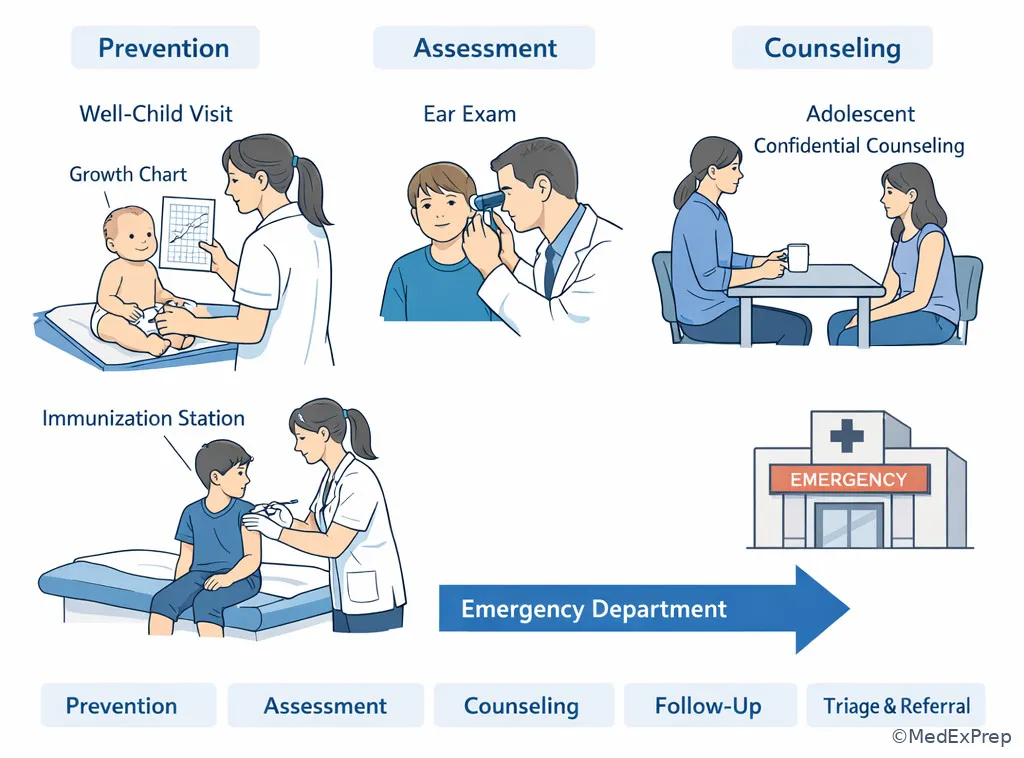
Outpatient pediatric primary care workflow illustration

Core content

1.1.1.1 Foundational scope: what the pediatric primary care NP is expected to do

A. Explanation

The first decision conflict is simple but heavily tested: Is this a routine outpatient pediatric problem that can be assessed and managed longitudinally, or is the stem pushing you beyond primary care scope? The resolving rule is this: choose the answer that matches clinic-based, age-appropriate, family-centered care for stable patients. Reject answers that assume inpatient resources, specialty-only diagnostics, or advanced resuscitation authority.

Core scope includes health supervision, developmental surveillance, immunization counseling, common acute visit assessment, common chronic follow-up, medication safety, caregiver teaching, and outpatient monitoring. It also includes recognizing when a problem exceeds office capability. WHY THIS IS TESTED: the exam often gives one very detailed option that sounds clinically sophisticated but actually belongs to the ED or inpatient unit, not pediatric primary care.

Choose actions such as focused history and exam, age-based interpretation, routine screening, basic ambulatory testing, initial supportive care, education, and scheduled reassessment. Reject actions such as managing ventilator settings, directing inpatient admission plans, determining operative approach, or independently running a subspecialty treatment pathway.

Concept flow: Stable outpatient care versus beyond-scope care
Identify setting
Read the stem as clinic, same-day visit, follow-up, or community triage unless told otherwise.

Decision
If stable and common outpatient problem → manage within primary care. If unstable or resource-intensive → escalate.

Execute safely
Add counseling, follow-up interval, red-flag return precautions, and documentation.

Memory anchor: Think CARE for primary care scope: Clinic assessment, Anticipatory guidance, Routine management and referral, Education with follow-up. If the answer goes beyond CARE, pause and ask whether it belongs to hospital or specialty care.

B. Worked example

A 7-year-old with mild persistent asthma and allergic rhinitis presents for cough for 2 days. He is eating less but still drinking, has a temperature of 37.8°C, oxygen saturation 98% on room air, mild end-expiratory wheeze, and no retractions. His mother reports “he probably needs a chest CT because his cousin had pneumonia.” He also had one episode of emesis after coughing. The task is the most appropriate next step in a primary care office.

Reasoning chain: Identify task: outpatient acute management, not hospital stabilization. Extract key facts: stable vitals, normal oxygenation, mild wheeze, no distress, common comorbidity pattern. Apply rule: stable child with common ambulatory problem stays in primary care scope. Eliminate distractors: chest CT is tempting because of caregiver anxiety and cough, but it is not first-line and exceeds routine need here. Hospital admission planning is wrong because the child is not unstable. Verify: focused asthma/viral assessment, office-appropriate treatment, education, and follow-up fit scope.

C. Exam trap

Common wrong answer: Ordering an advanced or hospital-level intervention because it sounds thorough.
Why it is tempting: Test-takers often equate more testing with safer care, especially when the parent is worried or the child has a chronic condition.
Single clue that eliminates it: The child is stable, oxygenating well, and the problem is a common outpatient presentation.

D. Checkpoint

Question: A 10-year-old presents for follow-up of constipation. He has autism spectrum disorder and obesity. His mother asks whether the clinic can arrange inpatient bowel cleanout today because he has not stooled in 4 days. He is afebrile, playful, hydrated, and has a soft abdomen without guarding. Which action is most appropriate?

  1. Develop an outpatient bowel regimen, provide caregiver teaching, and arrange follow-up.
  2. Arrange direct inpatient management for bowel cleanout from the clinic.
  3. Order urgent abdominal CT to exclude surgical abdomen.
  4. Delay intervention until the child develops vomiting or fever.
  • A: Tempting because it seems simple; correct because stable functional constipation belongs in outpatient primary care management.
  • B: Tempting because stool burden can sound severe; wrong because no instability or red flags justify hospital-level disposition.
  • C: Tempting because abdominal imaging feels definitive; wrong because the exam lacks peritoneal signs or acute abdomen features.
  • D: Tempting if you want more diagnostic certainty; wrong because delaying treatment ignores an appropriate office-based management opportunity.
If you missed this: Review 1.1.1.1 Foundational scope: what the pediatric primary care NP is expected to do — focus on the rule that stable, common outpatient problems stay in primary care unless red flags are present.
Nursing Priority: Assess first for ABC compromise, hydration, pain severity, and red flags. Intervene with the highest-priority outpatient action that fits the clinic setting. Delegate routine vitals, growth measures, and standardized screening collection appropriately, but interpretation, triage, and disposition stay with the NP/RN-level clinician. Escalate immediately if instability, severe pain, altered status, respiratory distress, or surgical concern appears.

1.1.1.2 Foundational boundary line: what must be escalated, referred, or transferred

A. Explanation

The next decision conflict is manage here versus escalate now. The single finding/rule that resolves it is instability or high-risk red flags. Pediatric primary care NPs are expected to recognize danger early, begin office-appropriate stabilization within capability, and secure a higher level of care. The exam rewards prompt escalation; it penalizes overconfident in-office management when the child is ill-appearing or the condition is time-sensitive.

Escalate for respiratory distress, oxygenation concerns, severe dehydration, altered mental status, concern for sepsis, anaphylaxis, suspected abuse, mental health crisis, severe abdominal findings, or any condition needing hospital-only resources. This is not “doing less”; it is the safest scope-appropriate action. WHY THIS IS TESTED: stems often include a child with just enough detail to tempt office treatment, but one red flag changes the entire answer.

Choose-vs-reject framing helps: choose emergency transfer when the problem threatens airway, breathing, circulation, neurologic status, or safety. Choose urgent same-day referral when the child is stable but needs specialty, ED, or hospital assessment beyond primary care resources. Reject routine follow-up when time-sensitive deterioration is plausible.

Concept flow: Red flags that override routine office care
Scan for danger
Appearance, work of breathing, hydration, mental status, safety risk, and severe pain come first.

Decision
If unstable or time-sensitive red flag → emergency transfer. If stable but beyond office capability → urgent referral.

Communicate clearly
Tell family why escalation is needed and document the red flag that drove disposition.

Fig 2. Disposition ladder for pediatric primary care
Exam takeaway: The correct answer often depends more on disposition urgency than on naming the exact diagnosis.
flowchart LR
A[Clinic/triage contact] --> B{Stable?}
B -- No --> C[EMS or ED now]
B -- Yes --> D{Needs resources beyond office?}
D -- Yes, same day --> E[Urgent referral/ED]
D -- Yes, not same day --> F[Specialty referral]
D -- No --> G[Outpatient management + follow-up]

Disposition is a high-yield exam skill. See Fig 2.

B. Worked example

A 3-month-old with a history of prematurity and reflux is brought for “poor feeding and cough.” He has nasal flaring, subcostal retractions, a respiratory rate of 68/min, and oxygen saturation of 90% on room air. His grandmother also mentions he has mild cradle cap, which is distracting but irrelevant. The most appropriate next step is not to optimize outpatient reflux care. The reasoning chain is: identify task as disposition; extract key facts of age, distress, hypoxemia, and tachypnea; apply rule that instability overrides routine office management; eliminate distractors such as same-day recheck or oral feeding trial; verify that urgent emergency evaluation/EMS activation is indicated.

C. Exam trap

Common wrong answer: Trial of office treatment with delayed reassessment.
Why it is tempting: In many primary care stems, supportive care and close follow-up are exactly right.
Single clue that eliminates it: Objective respiratory distress with low oxygen saturation changes the setting from routine outpatient care to emergency escalation.

D. Checkpoint

Question: A 15-year-old with depression and migraine presents for headache follow-up. During the visit she discloses current suicidal thoughts with a plan and says she does not want her parent told. Which action is most appropriate?

  1. Maintain confidentiality because adolescent privacy is generally protected.
  2. Complete routine headache counseling and schedule close follow-up next week.
  3. Initiate immediate safety assessment and urgent emergency mental health evaluation.
  4. Refer to outpatient counseling without involving the parent today.
  • A: Tempting because confidentiality is an important adolescent principle; wrong because imminent safety risk overrides routine privacy limits.
  • B: Tempting because headache was the original reason for visit; wrong because the new safety issue is higher priority.
  • C: Tempting because it is more intensive; correct because suicidal ideation with plan requires immediate escalation.
  • D: Tempting because counseling is appropriate long term; wrong because outpatient referral alone is insufficient for active danger.
If you missed this: Review 1.1.1.2 Foundational boundary line: what must be escalated, referred, or transferred — focus on the rule that instability or immediate safety risk outranks routine confidentiality and scheduled follow-up.
Quick Recall:

  • The most common reason to leave routine scope on exam stems is a red flag affecting disposition.
  • True or False: A stable child who needs a subspecialty procedure but not immediate stabilization usually needs planned referral, not emergency transfer. True.
  • Name 3 escalation triggers: respiratory distress, altered mental status, imminent safety risk.
High-Yield Connection: This concept is tested alongside Safest Next Step and Disposition And Follow-Up. Know both the disease clue and the setting clue; many stems are really disposition questions in disguise.
Nursing Priority: Assess airway, breathing, circulation, mental status, hydration, and immediate safety before disease-specific details. Intervene with oxygen/positioning/EMS activation within office protocol when indicated, and do not delay transfer for nonessential documentation. Delegate routine support tasks only after disposition is clear. Escalate immediately for respiratory compromise, suicidality, seizures, anaphylaxis, severe dehydration, or suspected abuse.

1.1.1.3 Applied scope in everyday pediatric primary care: prevention, common illness, and follow-up

A. Explanation

Once you know the child is stable and the problem fits outpatient care, the decision conflict becomes what is the NP expected to own longitudinally? The rule: primary care scope is broad in prevention and common ambulatory problems. It includes growth and development review, age-based screening, immunization counseling, common acute illness management, chronic condition follow-up, medication teaching, and return precautions.

This is where many learners under-call their role. The exam does expect you to make practical clinic decisions: which screening fits age, what counseling matters now, what follow-up interval is safe, and when a common problem can be treated without referral. WHY THIS IS TESTED: candidates sometimes defer too much because they are worried about overstepping. The correct answer is often an evidence-based outpatient plan with education, not unnecessary referral.

Choose management that includes assessment, action, family guidance, and monitoring. Reject answers that stop at diagnosis labeling without practical follow-up. In pediatric primary care, safe care nearly always includes caregiver instructions, developmental context, and a return plan.

Concept flow: Longitudinal primary care decision frame
Set context
Well visit, acute visit, chronic follow-up, or triage contact.

Choose action
Select age-appropriate assessment, counseling, or treatment that fits routine outpatient care.

Close the loop
Add monitoring, caregiver education, and specific return precautions.

Recall: In the upcoming topic Exam Domain Translation, you will turn broad areas like wellness, acute care, chronic care, and professional practice into question-recognition shortcuts. Here, we build on that by identifying which of those tasks actually belong to the pediatric primary care NP role.
Fig 3. Age-banded pediatric primary care responsibilities
Exam takeaway: Match the visit task to the child's age band to narrow the most appropriate outpatient action.
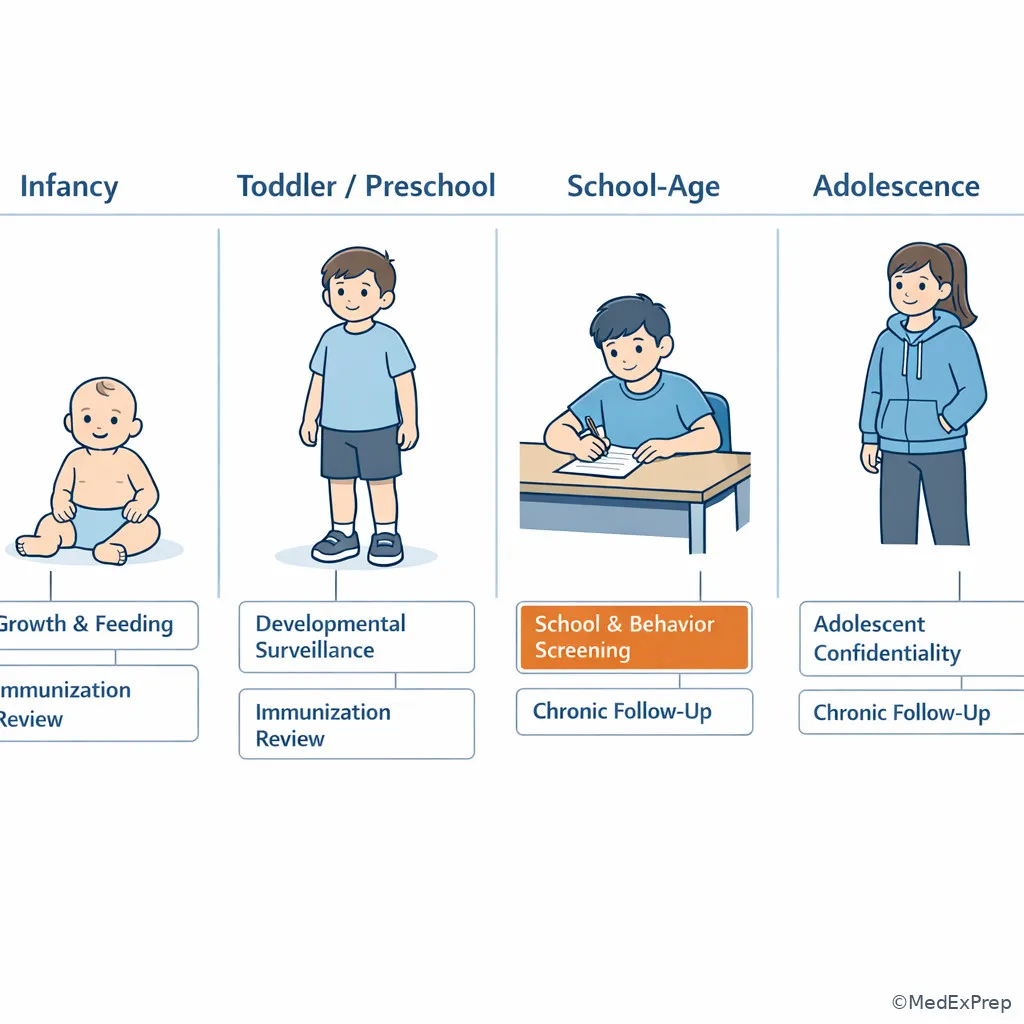
Fig 3. Age-banded pediatric primary care responsibilities

Age band is not decoration; it changes normal findings, screenings, counseling, and disposition thresholds. See Fig 3.

B. Worked example

An 18-month-old with eczema and a history of prematurity comes for a well visit. The father is worried that the child “still hates vegetables” and asks for a GI referral. The child is growing along prior percentiles, has normal energy, a normal exam, and no vomiting or diarrhea. A recent cousin’s celiac diagnosis is a tempting-but-wrong clue. Reasoning chain: identify task as preventive primary care. Extract key facts: age 18 months, stable growth, no alarm GI symptoms, typical feeding concern. Apply rule: primary care scope includes nutrition counseling, growth interpretation, developmental surveillance, and follow-up. Eliminate referral because there are no red flags. Verify: provide anticipatory guidance, monitor growth, address picky eating within primary care.

C. Exam trap

Common wrong answer: Referral for a common developmental or nutrition concern without growth or symptom red flags.
Why it is tempting: Family worry and family history can make routine issues sound pathologic.
Single clue that eliminates it: Normal growth trajectory and absence of alarm features support primary care counseling and monitoring.

D. Checkpoint

Question: A 12-year-old with ADHD and obesity presents for routine follow-up. Blood pressure is mildly elevated on one reading, she is due for immunization review, and her parent asks whether the NP should “wait for a specialist before discussing diet and activity.” Which action is most appropriate?

  1. Provide age-appropriate counseling, reassess the elevated reading properly, and continue primary care follow-up.
  2. Defer all counseling until subspecialty evaluation is complete.
  3. Refer immediately for inpatient blood pressure workup.
  4. Focus only on ADHD symptoms because that is the chronic diagnosis already established.
  • A: Tempting because it requires doing several routine tasks; correct because preventive counseling and reassessment fit longitudinal primary care scope.
  • B: Tempting when a family requests specialist input; wrong because primary care should not withhold basic counseling and monitoring.
  • C: Tempting because hypertension can be important; wrong because one mildly elevated reading in a stable child does not require inpatient evaluation.
  • D: Tempting because ADHD is the scheduled focus; wrong because primary care visits often address multiple preventive issues safely.
If you missed this: Review 1.1.1.3 Applied scope in everyday pediatric primary care: prevention, common illness, and follow-up — focus on the rule that longitudinal counseling, monitoring, and routine reassessment remain within primary care scope.
Nursing Priority: Assess whether the child is stable enough for routine outpatient management, then identify the visit type and age-based needs. Intervene with practical counseling, screening, and follow-up planning rather than unnecessary deferral. Delegate standardized screening administration and routine measurements when appropriate, but synthesis and counseling remain clinician responsibilities. Escalate if growth faltering, abnormal vitals persist, or new red flags emerge during a routine visit.

1.1.1.4 Integration: role limits in testing, treatment intensity, and consultation

A. Explanation

Another common exam conflict is how much testing or treatment intensity is appropriate before referral? The single rule is proportionality: in pediatric primary care, choose the least invasive, guideline-consistent outpatient step that safely answers the clinical question. Reject specialty-only or hospital-level intensity when a focused outpatient approach is sufficient.

This section is not about doing too little. It is about sequencing. A stable child with common symptoms usually gets a focused evaluation, not an exhaustive workup. A child with a likely office-manageable condition receives first-line care and monitoring, not escalation just because the diagnosis sounds important. Conversely, if the workup or treatment required is beyond office resources, referral is appropriate. WHY THIS IS TESTED: many distractors are “technically useful eventually” but wrong as the next step.

Choose-vs-reject examples: choose point-of-care or common outpatient labs when they inform immediate primary care management; reject subspecialty diagnostics not needed to make the next safe decision. Choose first-line education and follow-up for stable chronic issues; reject tertiary care plans that bypass the primary care role.

Concept flow: Match intensity to setting
Clarify question
Ask what decision must be made today in clinic.

Decision
If a common outpatient step answers it safely → do that. If not, consult or refer.

Reassess
Upgrade intensity only when persistence, severity, or red flags justify it.

Fig 4. Testing and treatment intensity ladder
Exam takeaway: Choose the lowest-intensity safe next step that fits outpatient pediatric primary care, then escalate only if the child's condition or required resources demand it.
flowchart TB
A[Need a decision today] --> B[Focused history and exam]
B --> C{Can routine outpatient test or treatment answer it?}
C -- Yes --> D[Use primary care step]
C -- No --> E[Consult or refer]
D --> F{Improving?}
F -- Yes --> G[Continue follow-up]
F -- No --> E

When two answers both sound medically reasonable, the lower-intensity guideline-consistent outpatient step is often right. See Fig 4.

B. Worked example

A 13-year-old with obesity and allergic rhinitis presents for 2 weeks of nasal congestion and cough. She has normal oxygen saturation, no fever, clear lungs, and no facial swelling. Her parent requests “the strongest antibiotic” because school testing is next week. There is also a distracting history of one prior pneumonia 3 years ago. Reasoning chain: identify the task as outpatient management of a common complaint. Extract key facts: stable, no severe features, short duration, benign pulmonary exam. Apply rule: primary care should use focused assessment and guideline-consistent management, not treatment intensity driven by request alone. Eliminate inpatient evaluation, imaging, and unnecessarily broad therapy. Verify: office-appropriate symptomatic management and follow-up are within scope.

C. Exam trap

Common wrong answer: The most aggressive intervention because it feels decisive.
Why it is tempting: Family pressure, chronic comorbidities, and remote past serious illness can make escalation feel safer.
Single clue that eliminates it: Current exam and vital signs do not show severity requiring high-intensity testing or treatment.

D. Checkpoint

Question: A 6-year-old with eczema and iron deficiency anemia follow-up presents with mild dysuria but is afebrile, well-appearing, and drinking normally. Which action best fits pediatric primary care scope?

  1. Obtain a focused history/exam and use common outpatient testing as indicated before deciding next steps.
  2. Arrange direct admission for IV antibiotics because urinary complaints can become serious.
  3. Order a subspecialty imaging panel before basic outpatient assessment.
  4. Reassure only and avoid any evaluation because the child is stable.
  • A: Tempting because it sounds basic; correct because primary care scope includes ambulatory assessment and common testing for stable complaints.
  • B: Tempting because urinary infection matters; wrong because the child lacks instability or severity demanding hospital care.
  • C: Tempting because structural causes are possible; wrong because specialty-level workup is not the first outpatient step in this stable presentation.
  • D: Tempting because the child looks well; wrong because stable does not mean ignore symptoms requiring standard evaluation.
If you missed this: Review 1.1.1.4 Integration: role limits in testing, treatment intensity, and consultation — focus on the discriminator that the next step should be the lowest-intensity safe outpatient action, not the most aggressive possible action.
Quick Recall:

  • The best next step is often the lowest-intensity safe outpatient action.
  • True or False: A subspecialty test can still be the wrong answer if it does not change the immediate primary care decision. True.
  • Name the sequence: focused assessment → routine outpatient step → reassess → escalate if needed.
Memory anchor: Use STEP for escalation logic: Stable? Task today? Expected outpatient resource enough? Prefer lowest safe intensity.
High-Yield Connection: This concept is tested alongside Question Task Recognition and later with Medication Safety Checks. On exam day, knowing whether the task is assess, test, treat, counsel, or refer prevents overcalling intensity.
Nursing Priority: Assess the immediate clinical question, severity, and what can be answered safely in clinic today. Intervene with focused outpatient testing/treatment first when appropriate. Delegate specimen collection or routine screening steps consistent with clinic workflow, but decision-making about escalation remains with the clinician. Escalate when required evaluation or therapy exceeds office resources or when reassessment shows worsening.

1.1.1.5 Integration: legal, ethical, and communication responsibilities within scope

A. Explanation

The final high-yield conflict is respect autonomy and confidentiality versus protect safety and meet legal duties. The single rule is this: family-centered and adolescent-sensitive care is expected, but safety, mandated reporting, and urgent risk management override routine confidentiality boundaries. The primary care NP must also communicate clearly about why escalation, reporting, or shared decision-making is required.

This includes informed, developmentally appropriate communication; confidentiality for adolescents when appropriate; mandated reporting for suspected abuse or neglect; culturally responsive care; medication safety teaching; and coordination of follow-up. WHY THIS IS TESTED: exam items often present a communication dilemma, but the real discriminator is whether a safety or legal threshold has been crossed.

Choose actions that preserve trust while meeting duty: explain confidentiality limits up front, involve caregivers when safety requires it, and report suspected maltreatment rather than “waiting for proof.” Reject answers that hide behind privacy, avoid difficult conversation, or delay action until certainty is complete. In primary care, communication is not separate from clinical care; it is part of safe disposition.

Concept flow: Confidentiality and safety balance
Start with privacy
Use developmentally appropriate confidential discussion when appropriate.

Decision
If imminent safety risk, abuse concern, or legal exception applies → disclose and escalate as required.

Document and plan
State the reason, notify appropriate parties, and arrange follow-up or emergency care.

Fig 5. Adolescent confidentiality with safety limits
Exam takeaway: Confidential care is important, but active self-harm risk, abuse, or immediate danger requires disclosure and escalation.
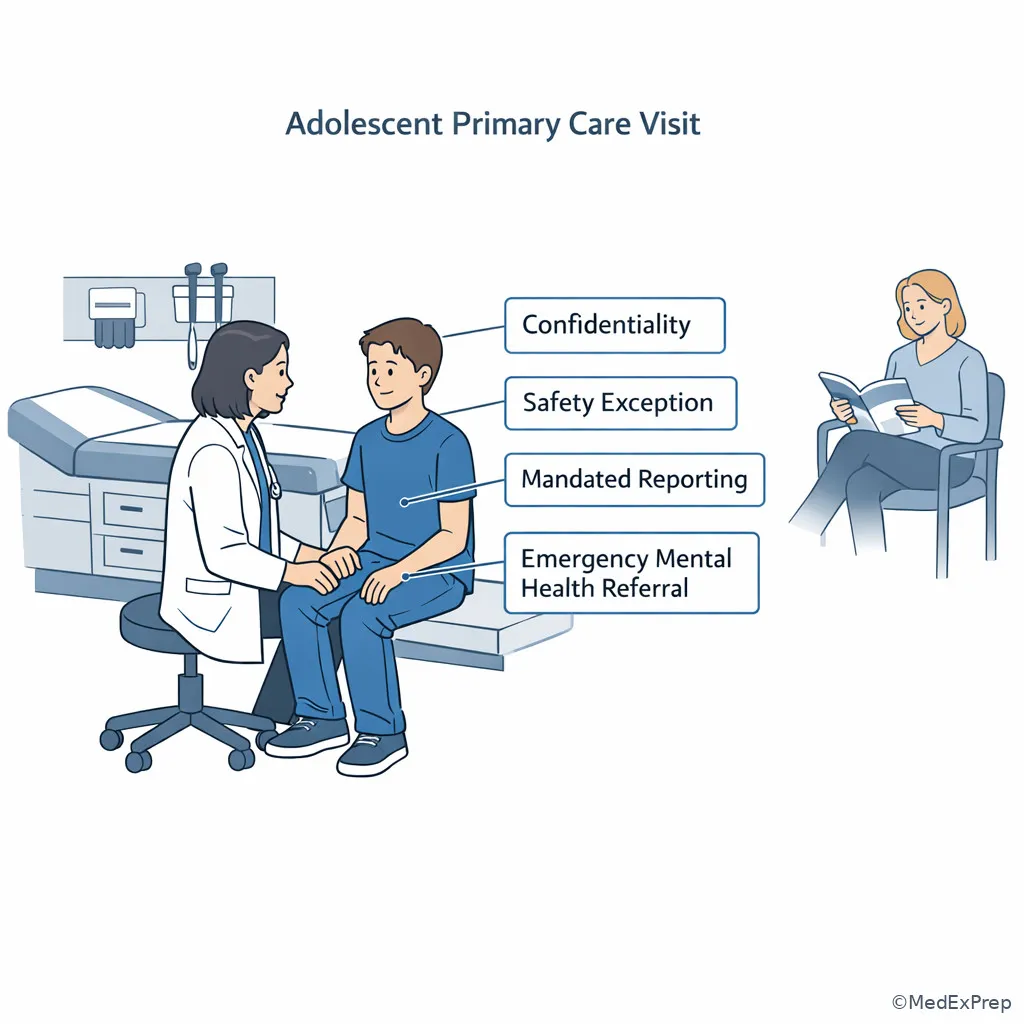
Fig 5. Adolescent confidentiality with safety limits

Confidentiality questions are really safety and legal threshold questions. See Fig 5.

B. Worked example

A 14-year-old presents for sports clearance with her mother. During confidential discussion, she reports that her mother’s boyfriend “sometimes hits my little brother” and asks the NP not to tell anyone. She also notes mild acne and wants treatment, which is distracting because it is a manageable primary care issue but not the priority. Reasoning chain: identify task as professional/legal action. Extract key facts: disclosure of suspected child abuse in the home, request for secrecy, no need for proof before action. Apply rule: mandated reporting overrides routine confidentiality. Eliminate distractors such as waiting to gather more evidence independently or simply encouraging the teen to tell a parent first. Verify: ensure immediate safety assessment, follow reporting requirements, document objectively, and coordinate next steps.

C. Exam trap

Common wrong answer: Delaying report until abuse is confirmed personally by the clinician.
Why it is tempting: Learners worry about overreporting or damaging trust with the family.
Single clue that eliminates it: The duty is to report suspicion, not to prove the case before acting.

D. Checkpoint

Question: A 16-year-old asks for confidential counseling about sexual health. She denies coercion, suicidal thoughts, and abuse, and she feels safe at home. Which action is most appropriate?

  1. Refuse any confidential discussion because the parent is in the room.
  2. Provide developmentally appropriate confidential counseling within legal and clinic guidelines.
  3. Notify the parent of all details before any counseling begins.
  4. Refer automatically to a specialist because confidentiality issues are outside primary care scope.
  • A: Tempting if you are cautious about consent; wrong because routine adolescent confidential discussion is part of primary care practice.
  • B: Tempting because it balances privacy and safety; correct because no immediate danger or legal exception is present in the stem.
  • C: Tempting because family involvement can help; wrong because automatic disclosure is not required when no safety exception exists.
  • D: Tempting if legal issues feel uncomfortable; wrong because confidential adolescent counseling is a core primary care competency.
If you missed this: Review 1.1.1.5 Integration: legal, ethical, and communication responsibilities within scope — focus on the discriminator that confidentiality is routine unless safety, abuse, or legal exceptions override it.
Nursing Priority: Assess immediate safety first, then confidentiality boundaries, then the communication plan. Intervene by explaining privacy limits clearly and documenting objective findings. Delegate non-sensitive routine tasks appropriately, but abuse assessment, suicidal-risk response, and mandated reporting decisions remain clinician responsibilities. Escalate immediately for imminent harm, abuse concern, or mental health crisis.

Tables

Primary care NP responsibility Typical examples Exam cue
Preventive care Well visits, growth review, screening, immunization counseling Stable child, age-banded tasks, anticipatory guidance needed
Common acute illness management URI care, mild asthma follow-up, constipation, uncomplicated skin concerns Common complaint without instability
Chronic follow-up ADHD follow-up, obesity counseling, eczema monitoring, asthma check-ins Longitudinal monitoring and education
Common ambulatory testing Point-of-care tests, routine outpatient labs, common office diagnostics Test changes clinic decision today
Family education and return precautions Medication teaching, hydration advice, red-flag guidance Board stems ask for best next step plus follow-up plan
Referral/consultation recognition Specialty referral, urgent same-day evaluation, ED transfer Beyond office resources or unstable child
Setting choice Choose when Reject when Typical wording in stems
Routine outpatient management Stable, common problem, no red flags Any ABC compromise or immediate danger “Most appropriate next step in clinic”
Urgent same-day referral Stable but needs resources beyond office capability If child is actively unstable and needs emergency transfer “Requires urgent evaluation today”
Emergency department / EMS Respiratory distress, severe dehydration, altered status, safety crisis Stable minor illness “Immediate evaluation” or “most appropriate disposition”
Planned specialty referral Persistent problem needing nonurgent subspecialty input When first-line primary care steps have not yet been tried without reason “Follow current official guidance and coordinate care”
Look-alike scenario Seems like Actually is Single discriminator
Well-appearing child with common complaint Needs exhaustive workup Focused outpatient management Stable vitals and no red flags
Teen requesting privacy Absolute confidentiality Confidential care with safety exceptions Presence or absence of imminent risk/abuse
Concerning chronic symptom with no instability Emergency transfer Urgent or planned specialty referral Stable child but beyond office resources
Parent requests aggressive therapy Do the strongest option Use guideline-consistent lowest safe intensity Current severity, not family pressure
Possible maltreatment disclosure Need proof before acting Mandated report of suspicion Duty is triggered by suspicion, not confirmation
Pediatric triage escalation illustration
Exam takeaway: Red-flag assessment findings should trigger escalation before routine office problem-solving.
{"prompt":"Clean nursing-education illustration on white background showing pediatric triage escalation: child with respiratory distress signs, pulse oximeter reading low, clinician assessing work of breathing, arrow pathway from clinic room to EMS/ED, labels for retractions, tachypnea, hypoxemia, altered mental status, severe dehydration; realistic ambulatory care style.","caption":"Pediatric triage escalation illustration\nExam takeaway: Red-flag assessment findings should trigger escalation before routine office problem-solving.","size":"1024x1024"}
Mandated reporting clinical communication diagram
Exam takeaway: In suspected abuse, objective documentation and prompt reporting outrank efforts to personally confirm the diagnosis.
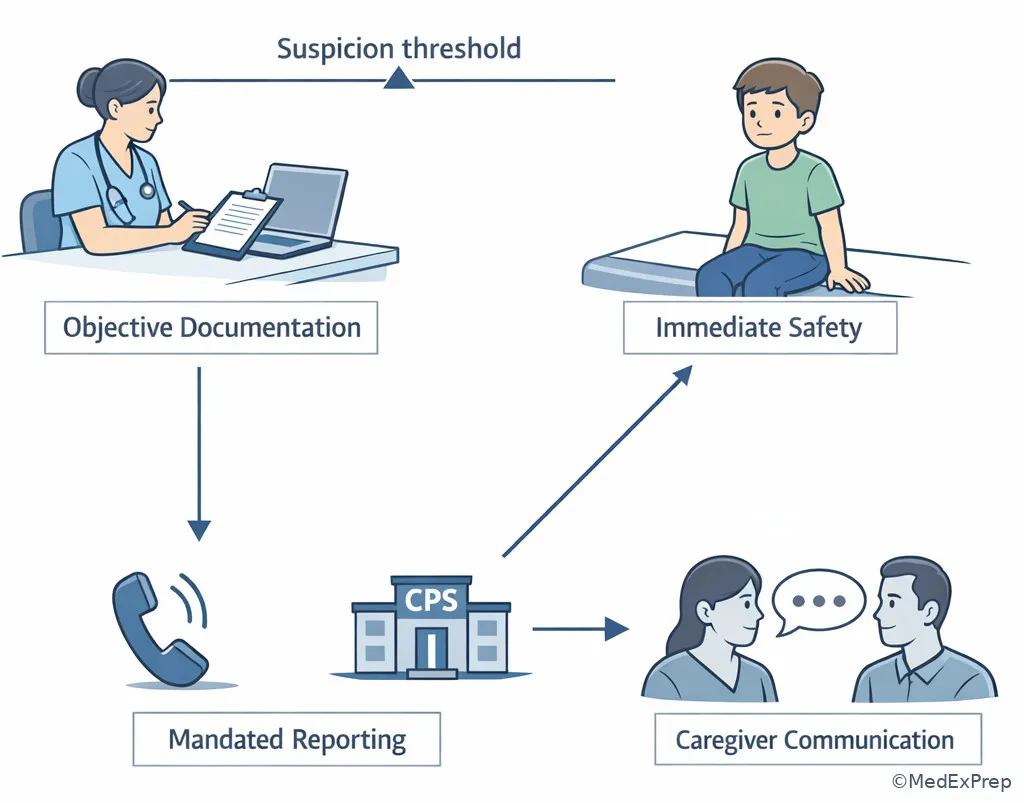
Mandated reporting clinical communication diagram

Exam Traps & Differentiators

  • Most common wrong answer and why: The “most advanced” intervention. It is tempting because it sounds comprehensive, but the exam usually wants the safest role-appropriate next step.
  • Looks similar but isn't: Stable-but-complex is not the same as unstable. A child can have multiple comorbidities and still be appropriate for outpatient management.
  • If the stem says low oxygen saturation, severe work of breathing, lethargy, dehydration signs, or suicidal plan, think emergency disposition first.
  • If the stem says normal growth, reassuring exam, common complaint, and parent anxiety, think outpatient counseling and follow-up rather than reflex referral.
  • If the stem says adolescent asks for privacy but denies safety concerns, think confidential counseling within legal limits.
  • If the stem says suspected abuse or neglect, think mandated reporting based on suspicion, not proof.
  • If the stem says test or treatment request “because a relative had something serious,” think current child’s presentation drives scope and intensity.
Stem clue Think Avoid
Stable vital signs, common complaint, no red flags Manage in primary care Hospital-level plan
Normal growth despite feeding concern Counsel and monitor Immediate GI referral without alarm signs
Respiratory distress or hypoxemia Emergency escalation Trial of routine outpatient reassessment only
Teen requests confidentiality with no danger Private counseling Automatic disclosure of all details
Suicidal plan or abuse concern Safety exception and escalation Preserve secrecy or wait for proof
Fig 6. Common distractor sorter
Exam takeaway: When two options seem reasonable, choose the one that matches the child's severity and the NP's outpatient role.
flowchart TD
A[Two plausible answers] --> B{One assumes hospital/specialty resources?}
B -- Yes --> C{Does the stem show instability or beyond-office need?}
C -- No --> D[Reject aggressive option]
C -- Yes --> E[Choose escalation/referral]
B -- No --> F{Which one adds counseling and follow-up?}
F -- More complete --> G[Prefer that option]
F -- Less complete --> H[Reject incomplete plan]

When answer choices feel close, use severity plus setting as your tiebreaker. See Fig 6.

Common traps & distractors: Related upcoming topics such as Question Task Recognition and Safest Next Step will build on this pattern. Many confusable pairs are not disease vs disease; they are assessment vs action or manage here vs escalate now.
Review connection: The traps above test scope-based disposition. If any felt unfamiliar, revisit 1.1.1.2 Foundational boundary line: what must be escalated, referred, or transferred before attempting the Self-check quiz.

Algorithm / Approach

Concept flow: Primary care NP scope algorithm for exam stems
Identify setting and age
Assume outpatient pediatric primary care unless the stem says otherwise; age band matters immediately.

Screen for red flags
If ABC compromise, severe dehydration, altered status, suicidality, or abuse concern → escalate first.

Ask whether this fits routine scope
Common stable outpatient problem → assess/manage/counsel. Needed resource beyond office → refer or consult.

Choose the lowest safe intensity
Use focused exam, common ambulatory testing, or first-line management before high-intensity options.

Close with education and follow-up
Add caregiver teaching, confidentiality or reporting actions if needed, and explicit return precautions.

Rapid Review

  • Stable common complaint → primary care management beats reflex referral.
  • Respiratory distress → disposition question before diagnosis question.
  • Normal growth with feeding concern → counsel and monitor, not automatic GI referral.
  • Teen confidentiality → routine unless safety/legal exception appears.
  • Suicidal plan → immediate safety escalation overrides routine privacy.
  • Suspected abuse → report suspicion; do not wait for proof.
  • Parent requests “strongest” treatment → current severity determines action, not family pressure.
  • Advanced diagnostic option → wrong if it does not change today’s outpatient decision.
  • Multiple comorbidities → do not assume beyond-scope if the child is stable.
  • Primary care answer choice → usually includes counseling, monitoring, and follow-up.
  • Referral choice → right when resources needed exceed office capability despite stability.
  • Hospital-level answer → right only when instability or hospital-only need is clearly present.

Self-check quiz

1. A 9-year-old presents for follow-up of allergic rhinitis and mild eczema. He is afebrile, playful, and breathing comfortably. His parent asks whether the NP should “send him to the hospital to finally figure everything out.” Which action is most appropriate?

  1. Provide routine outpatient follow-up, symptom review, and caregiver teaching.
  2. Arrange inpatient evaluation because he has more than one chronic condition.
  3. Request emergency transfer because chronic conditions can worsen unexpectedly.
  4. Delay all management until a specialist has evaluated both conditions.

2. A 16-year-old requests time alone during a routine visit to discuss sexual health. She denies abuse, coercion, suicidal thoughts, and feeling unsafe. Which action is most appropriate?

  1. Provide confidential counseling within legal and clinic guidelines.
  2. Refuse confidentiality because a caregiver brought her to the visit.
  3. Disclose all details to the caregiver immediately after the discussion.
  4. Refer all confidential adolescent issues out because they are outside primary care scope.

3. A 2-month-old with a history of late preterm birth presents for cough and decreased feeding. He has nasal flaring, retractions, respiratory rate 66/min, and oxygen saturation 91% on room air. His parent also mentions a mild diaper rash. Which action is most appropriate?

  1. Discuss diaper skin care and recheck breathing after feeding.
  2. Initiate urgent emergency evaluation/EMS based on respiratory distress.
  3. Schedule follow-up tomorrow because infants often look worse before improving.
  4. Provide routine outpatient cough guidance and return precautions.

4. A 13-year-old with obesity and ADHD presents for routine follow-up. One blood pressure reading is mildly elevated; she feels well and has no headache, chest pain, or neurologic symptoms. Her parent asks whether all counseling should wait until a cardiology visit. Which action is most appropriate?

  1. Repeat the blood pressure properly, provide counseling, and continue primary care follow-up.
  2. Arrange emergency transfer for possible hypertensive emergency.
  3. Defer all counseling until cardiology has evaluated her.
  4. Ignore the blood pressure because the child is asymptomatic.

5. A 5-year-old with constipation and autism spectrum disorder presents for abdominal discomfort. He is hydrated, afebrile, playful, and has a soft abdomen without guarding. A grandparent requests hospital admission for bowel cleanout because “he always gets worse.” Which action is most appropriate?

  1. Develop an outpatient bowel plan with education and follow-up.
  2. Arrange direct admission because constipation can become severe.
  3. Order advanced imaging before attempting primary care management.
  4. Do nothing today because the abdomen is soft.

6. A 15-year-old presents for sports clearance. During confidential discussion, he reports intermittent sadness for months and then states he has current suicidal thoughts with access to pills at home. He asks the clinician not to tell his father, who is in the waiting room. Which action is most appropriate?

  1. Maintain confidentiality and schedule urgent outpatient therapy within 48 hours.
  2. Conduct immediate safety intervention and arrange emergency mental health evaluation.
  3. Finish the sports physical first to reduce his anxiety before addressing the disclosure.
  4. Encourage him to tell his father at home and call back if thoughts worsen.

7. A 14-year-old presents for acne follow-up and privately reports that her stepfather “gets rough” with her younger sibling. She asks the NP not to document it until she can “figure things out.” She otherwise feels safe today and has normal vital signs. Which action is most appropriate?

  1. Delay action until the adolescent provides more detail at a later visit.
  2. Document objective information and follow mandated reporting procedures for suspected abuse.
  3. Call the stepfather directly to hear his explanation before deciding.
  4. Honor confidentiality fully because the disclosure involved a sibling, not the patient.

8. An 11-year-old with asthma, obesity, and anxiety presents with 3 days of cough. He is afebrile, oxygen saturation is 99% on room air, there are no retractions, and lungs have faint end-expiratory wheeze only. His mother requests chest CT and direct hospital admission because he had pneumonia at age 4. Which action is most appropriate?

  1. Arrange direct admission because the history of pneumonia raises the risk of rapid decline.
  2. Order advanced imaging now because multiple comorbidities make outpatient assessment unreliable.
  3. Use focused outpatient assessment and management with clear return precautions.
  4. Refer immediately to pulmonology before changing any outpatient plan.

Answer key

1. Answer: A

A. Tempting because it seems almost too basic; correct because the child is stable and the conditions are routine outpatient chronic problems. The discriminating clue is the well-appearing child with no red flags, which fits longitudinal primary care management. Source support: outpatient chronic symptom follow-up and family education align with pediatric primary care standards and nursing process prioritization of safe, least intensive appropriate care.

B. Tempting because multiple chronic diagnoses can feel complex; incorrect because complexity alone does not equal inpatient need. The discriminating clue is stability without acute deterioration, making hospital evaluation disproportionate.

C. Tempting because chronic disease can worsen; incorrect because emergency transfer is reserved for current instability or time-sensitive danger. The discriminating clue is normal appearance and comfortable breathing.

D. Tempting if the learner is overly cautious about scope; incorrect because routine management of allergic rhinitis and eczema remains squarely within pediatric primary care. The discriminating clue is that both conditions are common outpatient problems.

If you missed this: Review 1.1.1.1 Foundational scope: what the pediatric primary care NP is expected to do — focus on the rule that stable common outpatient conditions should be managed within primary care rather than automatically deferred.

2. Answer: A

A. Tempting because confidentiality questions can feel legally risky; correct because routine adolescent confidential counseling is part of primary care when no danger or mandatory disclosure trigger is present. The discriminating clue is explicit denial of abuse, coercion, suicidality, and unsafe home environment.

B. Tempting because the caregiver is physically present; incorrect because adolescent care commonly includes private discussion. The discriminating clue is absence of a safety exception.

C. Tempting because family involvement may be beneficial; incorrect because automatic disclosure would violate the expected confidentiality framework when no risk threshold is crossed. The discriminating clue is no stated legal or safety reason to disclose.

D. Tempting if confidentiality feels outside scope; incorrect because it is a core outpatient pediatric role. The discriminating clue is that the issue is common primary care counseling, not specialty-only management.

If you missed this: Review 1.1.1.5 Integration: legal, ethical, and communication responsibilities within scope — focus on the rule that adolescent confidentiality is routine unless safety or legal exceptions apply.

3. Answer: B

A. Tempting because diaper rash is a treatable outpatient issue and feeding matters in infants; incorrect because ABCs outrank minor skin care. The discriminating clue is nasal flaring, retractions, and low oxygen saturation.

B. Tempting because it is the highest-acuity option; correct because the infant shows objective respiratory distress requiring emergency-level evaluation. The discriminating clue is hypoxemia with increased work of breathing in a young infant.

C. Tempting because close follow-up is common in primary care; incorrect because waiting is unsafe when current distress is already present. The discriminating clue is that the child is unstable now, not possibly worse later.

D. Tempting because cough often receives supportive outpatient care; incorrect because routine guidance alone is inadequate in the setting of distress and low oxygen saturation. The discriminating clue is abnormal respiratory status, not the symptom label of cough.

If you missed this: Review 1.1.1.2 Foundational boundary line: what must be escalated, referred, or transferred — focus on the ABC discriminator that respiratory distress overrides routine outpatient management.

4. Answer: A

A. Tempting because it requires doing several ordinary tasks rather than a dramatic action; correct because a stable adolescent with one mildly elevated reading needs proper reassessment, counseling, and follow-up in primary care. The discriminating clue is mild elevation without symptoms of hypertensive emergency.

B. Tempting because blood pressure abnormalities can be serious; incorrect because emergency transfer is for severe symptoms or instability. The discriminating clue is the absence of headache, chest pain, neurologic symptoms, or severe acute illness.

C. Tempting because specialty input may eventually be helpful; incorrect because it delays appropriate primary care counseling and reassessment. The discriminating clue is that the NP can act safely now within scope.

D. Tempting because a single mildly elevated reading may normalize; incorrect because ignoring it misses an appropriate primary care follow-up responsibility. The discriminating clue is that reassessment is still required even in asymptomatic patients.

If you missed this: Review 1.1.1.3 Applied scope in everyday pediatric primary care: prevention, common illness, and follow-up — focus on the discriminator that stable outpatient monitoring and counseling remain the NP’s role.

5. Answer: A

A. Tempting because it seems conservative; correct because the child is stable, hydrated, and has no acute abdominal red flags. The discriminating clue is the soft, non-guarded abdomen with playful appearance, supporting outpatient management.

B. Tempting because constipation can become severe and the family is worried; incorrect because there is no current instability or failure of reasonable outpatient scope in the stem. The discriminating clue is the reassuring exam.

C. Tempting because advanced imaging sounds thorough; incorrect because specialty-level testing is not the first step for stable functional constipation without alarm findings. The discriminating clue is lack of peritoneal or obstructive signs.

D. Tempting because the child appears well; incorrect because symptoms still warrant standard outpatient management and counseling. The discriminating clue is that stable does not mean no action is needed.

If you missed this: Review 1.1.1.4 Integration: role limits in testing, treatment intensity, and consultation — focus on the rule to choose the lowest-intensity safe outpatient step before escalation.

6. Answer: B

A. Tempting because outpatient therapy is appropriate for many adolescents with depression; incorrect here because active suicidal thoughts with access to pills create an immediate safety risk. The discriminating clue is current suicidal ideation plus means.

B. Tempting because it is the most urgent option; correct because safety overrides confidentiality and routine visit goals. The discriminating clue is imminent self-harm risk, which requires emergency mental health evaluation.

C. Tempting because maintaining rapport can matter; incorrect because finishing the sports physical delays a life-safety intervention. The discriminating clue is that the urgent issue emerged during the visit and now outranks the original purpose.

D. Tempting because involving family is important and may reduce harm; incorrect because delaying until home without immediate safety response is unsafe. The discriminating clue is active current risk, not passive history alone.

If you missed this: Review 1.1.1.5 Integration: legal, ethical, and communication responsibilities within scope — focus on the rule that imminent safety risk overrides routine confidentiality and planned outpatient follow-up.

7. Answer: B

A. Tempting because more detail can feel necessary before a serious report; incorrect because mandated reporting is triggered by suspicion, not certainty. The discriminating clue is disclosure suggesting possible abuse of a child in the home.

B. Tempting because it may feel uncomfortable or adversarial; correct because the clinician must document objective information and follow reporting procedures when abuse is suspected. The discriminating clue is that the obligation does not depend on proving the allegation personally.

C. Tempting because gathering both sides may seem fair; incorrect because confronting the alleged perpetrator is not the clinician’s investigative role and may increase risk. The discriminating clue is that safe reporting pathways, not independent investigation, are within scope.

D. Tempting because the teen requested privacy and the sibling is not the patient; incorrect because mandated reporting applies to suspected child maltreatment, not only direct abuse of the patient. The discriminating clue is safety duty to the child at risk.

If you missed this: Review 1.1.1.5 Integration: legal, ethical, and communication responsibilities within scope — focus on the mandated-reporting discriminator that suspicion is sufficient to trigger action.

8. Answer: C

A. Tempting because asthma history, obesity, and prior pneumonia can make the case feel high risk; incorrect because the child is currently stable without respiratory distress or hypoxemia. The discriminating clue is normal oxygen saturation and lack of retractions.

B. Tempting because advanced imaging seems thorough in a child with comorbidities; incorrect because it exceeds the needed intensity for a stable outpatient cough/wheeze visit. The discriminating clue is the mild current exam, not the remote past pneumonia.

C. Tempting because it may feel less decisive than admission or imaging; correct because focused outpatient management with return precautions matches both severity and setting. The discriminating clue is stable status with only faint wheeze.

D. Tempting because pulmonology may be useful eventually; incorrect because immediate specialty referral before outpatient management is not the best next step for this stable presentation. The discriminating clue is that the problem remains within routine primary care scope today.

If you missed this: Review 1.1.1.4 Integration: role limits in testing, treatment intensity, and consultation — focus on the discriminator that current severity, not comorbidity count or parental anxiety, determines whether outpatient management is appropriate.

References

  • Burns, Catherine E., et al. Pediatric Primary Care. 7th ed., Elsevier, 2024.
  • Pediatric Nursing Certification Board. Certified Pediatric Nurse Practitioner-Primary Care Exam Content Outline and Candidate Resources. PNCB, current official materials.
  • Hagan, Joseph F., Jr., et al., editors. Bright Futures: Guidelines for Health Supervision of Infants, Children, and Adolescents. 4th ed., American Academy of Pediatrics, 2017, with current updates.
  • American Academy of Pediatrics. Red Book: 2024–2027 Report of the Committee on Infectious Diseases. 33rd ed., AAP, 2024.
  • American Academy of Pediatrics Committee on Child Abuse and Neglect. Policy statements and clinical reports on mandated reporting and evaluation of suspected maltreatment. AAP, current guidance.
  • NCSBN. Clinical Judgment and Nursing Process Frameworks and nursing scope/prioritization guidance. National Council of State Boards of Nursing, current resources.

Last reviewed: March 15, 2026

Lesson 2

Exam Domain Translation

Exam domain translation

This lesson teaches you how to convert broad CPNP-PC exam domains into concrete study targets and board-style decisions. The goal is not to memorize a list of domains; it is to recognize what the item is really asking you to do as a pediatric primary care NP.

What you'll learn

  • DOMAIN: Exam strategy and clinical reasoning -> Blueprint translation: Convert broad domains into studyable subskills such as immunizations, development, triage, pharmacology, and family education.
  • DOMAIN: Exam strategy and clinical reasoning -> Task classification: Sort questions into wellness, acute, chronic, behavioral, pharmacology, or professional-practice tasks.
  • DOMAIN: Exam strategy and clinical reasoning -> Age and setting filter: Use age band and outpatient care context to narrow the safest next step.
  • DOMAIN: Exam strategy and clinical reasoning -> Follow-up and education: Expect caregiver teaching, anticipatory guidance, and follow-up planning as part of many correct answers.
  • DOMAIN: Pediatric primary care scope -> Escalation boundaries: Separate primary care management from urgent referral, emergency activation, or specialty consultation.

Blueprint mapping

Domain: Exam strategy and clinical reasoning -> exam blueprint orientation -> domain-to-subskill translation. Official percentage weight is not provided in the source pack; do not invent one.

Estimated time

35-45 minutes

Prereqs

Primary Care NP Scope; basic familiarity with pediatric age bands.

Key outputs

You should be able to choose wellness vs acute vs chronic vs behavioral vs pharmacology vs professional-practice reasoning and reject answers that are outside outpatient pediatric primary care scope.

Why it matters

  • Broad exam domains are too large to study directly; translating them into testable subskills makes review efficient and retrieval-ready.
  • Many CPNP-PC items test the same clinical facts through different tasks: screen, counsel, treat, follow up, refer, or escalate.
  • The correct answer often depends less on the diagnosis label and more on the age band, visit type, severity, and primary care setting.
  • Family education and follow-up planning are not afterthoughts; they are often the safest board-style next step once red flags are absent.
Fig 1. Domain-to-subskill translation map
Exam takeaway: A broad domain becomes testable only when you convert it into age, setting, task, safety, and follow-up decisions.
graph TD
A[Broad blueprint domain]-->B[Studyable subskill]
B-->C[Age band]
B-->D[Visit type]
B-->E[Clinical task]
E-->F[Safest next step]
F-->G[Counseling and follow-up]

Use Fig 1 as the central model for this lesson: every broad domain should be translated into what the pediatric primary care NP must decide in the stem.

Blueprint orientation workspace
Exam takeaway: Organizing domains into subskills prevents scattered studying and improves question recognition.
{"prompt":"Professional educational illustration of a pediatric nurse practitioner study desk with a blueprint document being converted into labeled sticky notes for immunizations, development, acute illness, chronic care, pharmacology, triage, and family education; clean medical education style, no brand logos, no patient identifiers","caption":"Blueprint orientation workspace","size":"1024x1024"}

Key Terms & Must-Know Facts

Key terms

Blueprint domain
A broad tested content area, such as preventive care, acute illness, chronic management, pharmacology, or professional practice.
Subskill
A smaller action the learner can practice, such as choosing an age-appropriate screen, identifying a red flag, or counseling a caregiver.
Task type
The question action: assess, diagnose, screen, counsel, treat, follow up, refer, or escalate.
Age band
The developmental and physiologic context that changes screening, anticipatory guidance, differential diagnosis, and medication safety.
Care setting
The clinical frame, usually outpatient pediatric primary care, same-day sick visit, well visit, follow-up visit, school-linked clinic, telephone triage, or portal triage.
Safest next step
The action that best protects the child while staying within pediatric primary care NP scope.
Red flag
A finding that shifts the answer away from routine outpatient management toward urgent evaluation or emergency escalation.
Distractor
A plausible but wrong answer that fits part of the stem while ignoring the key discriminating clue.
Follow-up interval
The planned reassessment or safety-net step after initial outpatient management.
Family-centered counseling
Caregiver and patient education that is developmentally appropriate, culturally responsive, and actionable.
Professional-practice task
A question centered on confidentiality, consent, mandated reporting, care coordination, or scope of practice.
Out-of-role answer
An answer that asks the CPNP-PC candidate to function as an intensivist, surgeon, inpatient hospitalist, subspecialist, or emergency physician.

Must-know facts

  • Translate domains into decisions: what is the NP being asked to choose, rule out, counsel, prescribe, monitor, or escalate?
  • Age band is a primary filter because normal findings, screening needs, medication choices, and danger signs vary across infancy, childhood, adolescence, and young adulthood.
  • Visit type matters: well visit items often ask prevention; sick visit items often ask triage or initial management; follow-up items often ask monitoring and adjustment.
  • Do not over-specialize the answer. If the child needs specialty or emergency care, the primary care answer is recognition, stabilization within office capability, and referral or transfer.
  • Many items include a tempting clue that is real but not decisive; the decisive clue usually changes acuity, age category, contraindication, or follow-up need.
  • Family education and return precautions are frequently part of the correct outpatient plan.
  • When official guidance may change, the exam-safe principle is to follow current official guidance rather than memorize unsupported local rules.
Broad domain language Studyable subskills Typical board-style task
Well-child and preventive care Visit components, screening selection, anticipatory guidance, immunization logic Choose the age-appropriate preventive action
Growth, development, nutrition Growth pattern interpretation, milestone surveillance, feeding guidance, deficiency clues Distinguish normal variation from abnormal finding
Common acute presentations Fever, rash, respiratory symptoms, GI/GU symptoms, injury triage Identify initial outpatient management versus escalation
Chronic primary care conditions Asthma, eczema, constipation, anemia, obesity, follow-up monitoring Adjust longitudinal plan or identify poor control
Pharmacology and safety Weight-based dosing logic, formulation check, adverse effect counseling Verify safe medication use and caregiver instructions
Professional practice Confidentiality, consent limits, mandated reporting, coordination, referral Select the ethical, legal, and safest next step
Fig 2. Pediatric primary care domain dashboard
Exam takeaway: The same pediatric stem can shift domains depending on whether the task is prevention, diagnosis, treatment, follow-up, safety, or professional judgment.
{"prompt":"Clean dashboard-style medical education illustration showing six labeled tiles for pediatric primary care exam domains: wellness and prevention, growth development nutrition, acute illness, chronic care, pharmacology safety, and professional practice; pediatric clinic background, diverse child and caregiver silhouettes, no logos","caption":"Pediatric primary care domain dashboard","size":"1024x1024"}

See Fig 2 for the mental dashboard to use before answering a question.

Core content

1. Translate broad domains into studyable subskills

A. Explanation

Decision conflict: choose a concrete study action instead of trying to memorize a broad category label. WHY THIS IS TESTED: certification questions rarely ask, 'Which domain is this?' They present a child, age, setting, and problem, then ask the safest primary care decision. A learner who studies only broad domains may recognize the topic but miss the task.

Start with the domain, then ask: What would a pediatric primary care NP need to do? For immunizations, the subskill may be routine schedule logic, catch-up principles, contraindications, or counseling. For development, it may be milestone surveillance, formal screening, autism recognition, or referral threshold. For triage, it may be office care versus emergency evaluation. This is the transition from passive blueprint reading to active question readiness.

1. Name the domainExample: preventive care.
2. Break into subskillsScreening, immunization, counseling, injury prevention.
3. Add age bandInfant, toddler, school-age child, adolescent, young adult.
4. Add task verbChoose, counsel, monitor, refer, or escalate.
5. Practice as a next-step decisionAnswer what the NP should do now.
Subskill sorting board
Exam takeaway: Subskills make the blueprint operational by converting content areas into actions the NP can perform.
{"prompt":"Educational illustration of a pediatric NP organizing a whiteboard into columns labeled domain, subskill, age band, task verb, safest next step; examples include immunization counseling, developmental surveillance, asthma follow-up, fever triage; clean clinic classroom style","caption":"Subskill sorting board","size":"1024x1024"}

B. Worked example

Vignette with noise: A 4-year-old comes for a well-child visit. The caregiver is worried because the child is picky, has mild eczema, and sometimes reverses letters when drawing. The child attends preschool, has normal growth on the same percentile curve, and has no developmental regression. The question asks for the most appropriate study category to review for similar items.

  1. Identify task: This is not asking for eczema treatment or a reading-disorder diagnosis; it asks how to translate the domain.
  2. Extract key facts: Age 4 years, well visit, growth stable, caregiver concern, no red flags.
  3. Apply rule: Well visit plus age-specific expectations maps to preventive care, developmental surveillance, nutrition counseling, and anticipatory guidance.
  4. Eliminate distractors: Mild eczema is noise; letter reversal at this age is not enough to force a specialty-only pathway in this source context.
  5. Verify: The study target should be age-based well-child preventive care and developmental surveillance rather than inpatient management or subspecialty testing.

C. Exam trap

Common wrong answer: Study only diagnosis labels. Why it is tempting: The stem often contains a condition name, symptom, or caregiver concern. Single clue that eliminates it: The question asks for a preventive, counseling, follow-up, or safest-next-step action rather than simply naming a disease.

D. Checkpoint MCQ

Question: A learner is reviewing the broad domain 'growth and development.' Which translation is most useful for board-style preparation?

  1. A. Memorize every rare genetic syndrome associated with short stature.
  2. B. Practice age-based growth interpretation, developmental surveillance, screening triggers, and referral thresholds.
  3. C. Focus on inpatient endocrine workups for complex growth disorders.
  4. D. Study only normal milestone lists without applying them to visit context.

Answer: B. A is tempting because rare disorders appear important, but it is too subspecialty-heavy for foundational primary care review. B is correct because it converts the broad domain into actionable primary care subskills. C is tempting because growth abnormalities can require referral, but inpatient workup is outside routine exam framing. D is tempting because milestones are high-yield, but lists alone do not teach what to do with abnormal findings.

If you missed this: Review Translate broad domains into studyable subskills - focus on converting content labels into outpatient NP decisions.

2. Classify the question by clinical task before choosing an answer

A. Explanation

Decision conflict: choose the task the question is testing before choosing the clinical answer. WHY THIS IS TESTED: the same patient can support several correct clinical statements, but only one matches the requested task. A child with wheeze can generate questions about diagnosis, severity, medication safety, caregiver education, follow-up, or escalation.

Use six practical task buckets: wellness/prevention, acute illness, chronic follow-up, behavioral/developmental, pharmacology/safety, and professional practice. This classification prevents you from answering a treatment question with a screening answer or a triage question with routine reassurance.

1. Read the lead-inWhat is the most appropriate next step?
2. Identify the visit typeWell visit, sick visit, follow-up, triage, confidential adolescent visit.
3. Choose the task bucketWellness, acute, chronic, behavioral, pharmacology, professional.
4. Match answer to taskReject true facts that do not answer the task.
Fig 3. Task bucket decision visual
Exam takeaway: Classifying the task first keeps you from choosing a true statement that does not answer the question.
graph LR
A[Lead-in]-->B{What is being asked?}
B-->C[Wellness or prevention]
B-->D[Acute illness]
B-->E[Chronic follow-up]
B-->F[Behavioral or developmental]
B-->G[Medication safety]
B-->H[Professional practice]
C-->I[Screen counsel immunize]
D-->J[Treat vs escalate]
E-->K[Assess control and adjust]
F-->L[Screen refer support]
G-->M[Dose formulation adverse effects]
H-->N[Consent confidentiality reporting]

See Fig 3 when a stem contains many clinically true details but the lead-in asks for only one type of action.

Question task triage cards
Exam takeaway: The lead-in determines whether the correct answer should screen, counsel, treat, follow up, refer, or report.
{"prompt":"Medical education illustration of six labeled cards on a pediatric exam table: wellness prevention, acute illness, chronic follow-up, behavioral developmental, medication safety, professional practice; each card has a simple icon such as vaccine, thermometer, inhaler, school notebook, medicine bottle, shield; clean flat style","caption":"Question task triage cards","size":"1024x1024"}

B. Worked example

Vignette with noise: A 10-year-old with mild persistent asthma, allergic rhinitis, and obesity comes for follow-up. The caregiver reports two nighttime cough episodes this month, missed controller doses twice weekly, and a normal oxygen saturation today. The child also has a mild sore throat. The lead-in asks: 'Which study task is most directly tested by this item?'

  1. Identify task: The lead-in asks for task classification, not final asthma treatment.
  2. Extract key facts: Chronic condition follow-up, adherence issue, asthma control clues, normal current oxygenation.
  3. Apply rule: Chronic follow-up items test control assessment, adherence barriers, medication safety, education, and follow-up.
  4. Eliminate distractors: Sore throat is noise unless the question shifts to acute pharyngitis. Normal oxygen saturation does not erase chronic control concerns.
  5. Verify: Classify as chronic primary care follow-up with medication adherence and caregiver education components.

C. Exam trap

Common wrong answer: Treat every symptom mentioned in the stem. Why it is tempting: Pediatric stems often include realistic noise such as mild sore throat, eczema, school concerns, or parental anxiety. Single clue that eliminates it: The lead-in points to the task bucket, and the correct answer must match that task.

D. Checkpoint MCQ

Question: A 15-year-old presents for a confidential visit about vaping and sexual health. Which task bucket should guide the first layer of domain translation?

  1. A. Professional practice and adolescent preventive care.
  2. B. Neonatal intensive care stabilization.
  3. C. Operative gynecologic planning.
  4. D. Inpatient psychiatric medication titration.

Answer: A. A is correct because confidentiality, consent limits, substance use, and sexual health fit adolescent preventive and professional-practice reasoning. B is tempting only if the learner overgeneralizes safety language, but the age and setting eliminate NICU care. C is tempting because sexual health can involve reproductive concerns, but operative planning is out of role. D is tempting if mental health risk appears, but inpatient titration is not the first domain translation without crisis details.

If you missed this: Review Classify the question by clinical task before choosing an answer - focus on using the lead-in and setting before reacting to symptoms.
Quick Recall:

  • Fill in the blank: A true clinical statement can still be wrong if it does not match the ____.
  • True or false: The same asthma stem can test acute triage, chronic control, medication safety, or family education depending on the lead-in.
  • One-liner: In domain translation, the lead-in tells you the action, while the stem tells you the context.

3. Use age band and care setting as the narrowing filter

A. Explanation

Decision conflict: choose the answer that fits the child's developmental stage and outpatient setting rather than the answer that sounds most medically aggressive. WHY THIS IS TESTED: pediatric primary care is age-dependent. Normal behavior, screening priorities, medication safety, developmental expectations, and escalation thresholds change across infancy, toddlerhood, school age, adolescence, and young adulthood.

Age and setting are not background details; they are filters. A fever in a young infant has a different urgency than a fever in an older well-appearing child. A preventive screening question at a well visit differs from a same-day respiratory distress triage question. A portal message requires triage logic and safety-net instructions, not a full office exam that has not occurred.

1. Identify age bandNewborn/infant, toddler, school-age, adolescent, young adult.
2. Identify settingWell visit, sick visit, chronic follow-up, phone/portal triage.
3. Apply age-specific expectationsScreening, development, nutrition, immunization, safety.
4. Check severityStable outpatient care versus urgent escalation.
5. Select scoped actionEducate, treat, monitor, refer, or transfer.
Age/setting clue What it narrows Common answer direction
Infant well visit Feeding, growth, immunizations, caregiver safety counseling Preventive guidance and age-appropriate screening
Toddler behavior concern Developmental norms, parent guidance, safety, sleep, elimination Surveillance, counseling, or formal screening if indicated
School-age chronic follow-up Control, adherence, school functioning, family plan Assess control and adjust outpatient plan
Adolescent confidential visit Privacy, consent limits, risk screening, safety Confidential care with clear exceptions for danger or reporting
Portal or phone message Limited assessment, red flags, disposition Triage, safety-net advice, office visit, urgent care, or emergency referral
Fig 4. Age and setting narrowing filter
Exam takeaway: Age band and visit type often eliminate answers before disease-specific facts are needed.
graph TD
A[Stem]-->B[Age band]
A-->C[Care setting]
B-->D[Normal vs abnormal for age]
C-->E[Preventive acute chronic triage]
D-->F[Candidate actions]
E-->F
F-->G[Scoped safest next step]

See Fig 4 whenever answer choices differ mainly by intensity of action.

Age-band clinic wall chart
Exam takeaway: Pediatric exam reasoning starts by placing the child in the correct developmental and care-setting frame.
{"prompt":"Pediatric primary care clinic wall chart showing age bands from infant to toddler to school-age child to adolescent to young adult, with small icons for growth, vaccines, development, behavior, confidentiality, and triage; professional medical education illustration","caption":"Age-band clinic wall chart","size":"1024x1024"}

B. Worked example

Vignette with noise: A 2-month-old is brought for a health supervision visit. The caregiver reports mild spit-up, a sibling with a cold, and concern about vaccine discomfort. The infant is feeding well and has appropriate growth. The lead-in asks what kind of subskills should be prioritized when studying this domain.

  1. Identify task: Domain translation for an infant well visit.
  2. Extract key facts: Age 2 months, well visit, feeding and growth reassuring, caregiver vaccine concern.
  3. Apply rule: Infant preventive care maps to growth/feeding assessment, routine immunization counseling, safety guidance, and red-flag recognition.
  4. Eliminate distractors: Sibling cold is distracting unless infant illness or instability appears. Spit-up without growth concern is not the dominant task in this source context.
  5. Verify: The study plan should prioritize age-based prevention and counseling, not aggressive acute management.

C. Exam trap

Common wrong answer: Choose the most intensive medical action because the patient is young. Why it is tempting: Young age can increase risk and makes learners cautious. Single clue that eliminates it: The visit is a stable well-child encounter without red flags; prevention and counseling are the tested task.

D. Checkpoint MCQ

Question: Which stem feature most directly helps translate a broad respiratory domain into either outpatient management or urgent escalation?

  1. A. The child's favorite sport.
  2. B. The caregiver's occupation.
  3. C. The presence or absence of respiratory distress and the care setting.
  4. D. The brand name of a previously used over-the-counter product.

Answer: C. A can matter for return-to-play counseling but does not define initial acuity. B may affect social context but is not the main respiratory domain filter. C is correct because respiratory distress and setting determine whether primary care management is appropriate or escalation is required. D is tempting because medications matter, but brand details rarely override severity and setting.

If you missed this: Review Use age band and care setting as the narrowing filter - focus on age plus acuity before selecting management intensity.

4. Recognize family education and follow-up as tested outcomes

A. Explanation

Decision conflict: choose education and follow-up when the child is stable and the main risk is misunderstanding, poor adherence, delayed return, or unsafe home care; reject unnecessary escalation when red flags are absent. WHY THIS IS TESTED: pediatric primary care questions often reward complete outpatient plans, not isolated diagnoses. Correct answers frequently include caregiver instructions, return precautions, monitoring, adherence support, and planned follow-up.

Family education is especially important for anticipatory guidance, medication administration, chronic disease control, vaccine hesitancy, injury prevention, sleep, nutrition, and triage advice. Follow-up converts a reasonable initial plan into a safe primary care plan. In exam items, an answer that treats but gives no safety-net instructions may be less complete than one that treats, educates, and defines when to return.

1. Confirm stabilityNo immediate red flags or emergency features.
2. Identify home-care riskMedication use, hydration, symptoms to monitor, adherence.
3. Teach the familyClear instructions and expected course.
4. Add safety netReturn precautions and when to escalate.
5. Schedule follow-upReassess if symptoms persist, worsen, or control is poor.
Fig 5. Family education and follow-up loop
Exam takeaway: Stable outpatient management is incomplete unless the family knows what to do, what to watch for, and when to return.
{"prompt":"Warm professional pediatric primary care scene showing nurse practitioner counseling a caregiver and adolescent at a clinic desk, with visible checklist icons for diagnosis, medication instructions, return precautions, and follow-up plan; diverse family, clean medical education illustration","caption":"Family education and follow-up loop","size":"1024x1024"}

See Fig 5 for the outpatient completion loop: diagnose or assess, educate, safety-net, and follow up.

B. Worked example

Vignette with noise: A 7-year-old with allergic rhinitis and constipation is seen for a mild viral upper respiratory syndrome. The caregiver requests antibiotics because a cousin recently had pneumonia. The child is afebrile in clinic, hydrated, breathing comfortably, and has a normal lung exam. The lead-in asks for the most exam-relevant outcome in similar outpatient items.

  1. Identify task: Acute outpatient illness management and caregiver education.
  2. Extract key facts: Stable child, viral pattern, caregiver concern, distracting family pneumonia story.
  3. Apply rule: When red flags are absent, management emphasizes supportive care, counseling, return precautions, and follow-up if worsening.
  4. Eliminate distractors: Antibiotics are tempting because caregiver requests them, but the stem lacks bacterial features in this source context. Emergency referral is tempting because pneumonia is mentioned, but it is not the child's presentation.
  5. Verify: The correct domain translation includes acute illness, antimicrobial stewardship, caregiver education, and safety-net follow-up.

C. Exam trap

Common wrong answer: Pick a medication-only answer. Why it is tempting: Board questions often include a symptom that appears treatable. Single clue that eliminates it: The stable outpatient context and caregiver concern make education, expected course, and return precautions central.

D. Checkpoint MCQ

Question: In domain translation, which subskill is most likely to be tested after a stable child receives initial outpatient management for a common acute illness?

  1. A. Inpatient order-set selection.
  2. B. Family education, return precautions, and follow-up planning.
  3. C. Operative risk stratification.
  4. D. Ventilator parameter adjustment.

Answer: B. A is tempting only if the learner over-medicalizes acute illness, but inpatient orders are out of role. B is correct because outpatient pediatric primary care plans often hinge on caregiver education and follow-up. C is tempting when symptoms could theoretically worsen, but surgery is not part of routine primary care scope. D is tempting in severe respiratory discussions, but no critical care context is provided.

If you missed this: Review Recognize family education and follow-up as tested outcomes - focus on completing stable outpatient plans with safety-net instructions.
Quick Recall:

  • Fill in the blank: A stable outpatient plan should include treatment, caregiver education, return precautions, and ____.
  • True or false: A medication answer can be incomplete if it ignores safety-net counseling.
  • One-liner: If red flags are absent, the exam may test safe home management rather than escalation.

5. Keep domain translation inside pediatric primary care scope

A. Explanation

Decision conflict: choose recognition, initial stabilization within office capability, consultation, referral, or emergency transfer instead of specialty-only management when the presentation exceeds outpatient primary care scope. WHY THIS IS TESTED: the CPNP-PC role is comprehensive primary care, not inpatient intensive care, surgery, procedural sedation, or subspecialty management. The exam expects safe scope boundaries.

Scope does not mean ignoring serious illness. It means recognizing when the safest primary care action is escalation. For unstable children, suspected abuse, severe dehydration, respiratory distress, sepsis concern, mental health crisis, or other high-risk presentations, the testable action is not definitive inpatient treatment. It is urgent evaluation, emergency activation, mandated reporting when applicable, or referral/consultation consistent with the risk.

1. Look for red flagsInstability, severe distress, dehydration, sepsis, abuse, crisis.
2. Ask if outpatient care is safeCan this be managed in primary care today?
3. If yesTreat, educate, safety-net, follow up.
4. If noStabilize within capability and escalate.
5. Reject out-of-role answersNo ventilator management, operative planning, or inpatient order sets.
Scope boundary decision tree
Exam takeaway: When risk exceeds outpatient primary care, the correct answer is escalation rather than specialty-only definitive management.
graph TD
A[Primary care stem]-->B{Red flags or instability?}
B--No-->C[Outpatient assessment and plan]
C-->D[Education follow-up safety net]
B--Yes-->E[Stabilize within office capability]
E-->F[Urgent referral emergency transfer or mandated reporting]
F-->G[Do not choose specialty-only definitive management]
Primary care escalation boundary
Exam takeaway: Scope-safe answers recognize danger and arrange the right level of care without pretending the NP is the inpatient specialist.
{"prompt":"Pediatric clinic triage illustration showing a nurse practitioner at a decision point with two paths: outpatient care with counseling and follow-up versus urgent escalation to emergency care; include red flag icons for respiratory distress, dehydration, sepsis concern, abuse concern, and mental health crisis; clean professional style","caption":"Primary care escalation boundary","size":"1024x1024"}

B. Worked example

Vignette with noise: A 13-year-old with ADHD and mild asthma is brought to a primary care office for abdominal pain and vomiting. The caregiver mentions the teen has an upcoming school exam. The teen appears lethargic, has dry mucous membranes, and cannot keep fluids down. The lead-in asks what domain translation best prepares for this type of item.

  1. Identify task: Acute illness triage and safe disposition.
  2. Extract key facts: Adolescent, outpatient office, vomiting, lethargy, dehydration signs, distracting school stress.
  3. Apply rule: Red flags shift the task from routine outpatient GI management to urgent evaluation/escalation.
  4. Eliminate distractors: Stress is tempting but does not explain dehydration risk. ADHD and asthma are comorbidities but not the decision-driving clue.
  5. Verify: Domain translation should emphasize red flag recognition, urgent disposition, and scope boundaries.

C. Exam trap

Common wrong answer: Continue routine outpatient management because the symptom is common. Why it is tempting: Vomiting, fever, cough, rash, and pain are common pediatric complaints. Single clue that eliminates it: A red flag such as lethargy, respiratory distress, severe dehydration, safety threat, or suspected abuse changes the task to escalation.

D. Checkpoint MCQ

Question: Which answer choice best reflects scope-safe domain translation for a child with severe respiratory distress in a primary care office?

  1. A. Manage ventilator settings after intubation.
  2. B. Recognize instability, provide initial office-level support within capability, and activate emergency transfer.
  3. C. Schedule routine follow-up in two weeks.
  4. D. Refer to pulmonology without addressing current distress.

Answer: B. A is tempting because severe distress is critical, but ventilator management is out of CPNP-PC primary care scope. B is correct because it recognizes the red flag and escalates safely. C is tempting in chronic respiratory care but unsafe for current distress. D is tempting because pulmonology may be involved later, but immediate instability requires emergency action.

If you missed this: Review Keep domain translation inside pediatric primary care scope - focus on red flags that convert management into escalation.

Exam Traps & Differentiators

Most common wrong answer: Choosing the answer that names the disease or intervention instead of the answer that matches the task. Why it is tempting: The disease label feels like the central fact. Single clue that eliminates it: The lead-in asks for a next step, counseling point, screening action, follow-up plan, or escalation threshold.
Looks similar But is not Discriminating clue
Preventive care question Acute illness treatment question Well visit, no acute instability, age-based screening or counseling requested
Chronic follow-up question Same-day acute crisis question Control, adherence, symptom frequency, longitudinal plan
Behavioral/developmental concern Emergency mental health crisis Safety risk, suicidal ideation, abuse concern, or inability to maintain safety
Medication knowledge question Medication safety question Weight, formulation, caregiver administration, contraindication, adverse effect
Primary care referral Specialty-only definitive management Question asks what the NP should do, not how the specialist should treat
Fig 6. Choose-vs-avoid answer filter
Exam takeaway: The best answer fits age, setting, task, safety, scope, and follow-up; avoid answers that fail any one of these filters.
graph TD
A[Answer choice]-->B{Fits age?}
B--No-->X[Avoid]
B--Yes-->C{Fits setting?}
C--No-->X
C--Yes-->D{Matches task?}
D--No-->X
D--Yes-->E{Safe and in scope?}
E--No-->X
E--Yes-->F{Includes education or follow-up when needed?}
F--No-->G[Possibly incomplete]
F--Yes-->H[Strong candidate]

Use Fig 6 as a final answer filter after you translate the domain.

Distractor elimination checklist
Exam takeaway: A tempting answer is usually eliminated by one clue: age, setting, task, red flag, contraindication, or scope boundary.
{"prompt":"Close-up educational illustration of a board exam answer checklist with six boxes: age, setting, task, red flag, medication safety, scope boundary; a pediatric NP pencil checks boxes while eliminating distractors; clean modern medical learning style","caption":"Distractor elimination checklist","size":"1024x1024"}

If the stem says ___, think ___

  • Well visit plus caregiver concern -> prevention, screening, anticipatory guidance, and reassurance versus referral depending on abnormal findings.
  • Stable child with common acute symptoms -> initial outpatient management, caregiver education, return precautions, and follow-up.
  • Chronic condition follow-up -> assess control, adherence, triggers, medication technique, and need for plan adjustment.
  • Adolescent confidential concern -> privacy, consent limits, risk screening, safety exceptions, and culturally responsive counseling.
  • Red flag or instability -> urgent evaluation, emergency transfer, mandated reporting if applicable, or specialty referral rather than routine management.
  • Medication in a child -> weight-based dosing logic, formulation, contraindication, caregiver administration, and adverse effects.
Review connection: Return to Classify the question by clinical task before choosing an answer if you find yourself choosing answers because they sound medically true rather than because they answer the lead-in.

Algorithm / Approach

1. Translate the domainName the broad content area and convert it into a studyable subskill.
2. Identify age and settingUse age band and visit type to narrow what is normal, risky, or expected.
3. Classify the taskWellness, acute, chronic, behavioral/developmental, pharmacology, or professional practice.
4. Screen for red flags and scopeDecide outpatient care versus urgent escalation, referral, or emergency transfer.
5. Complete the planAdd education, return precautions, follow-up, and medication safety checks when relevant.

Self-check quiz

Question 1

A broad exam domain lists immunizations and preventive counseling. Which study approach best translates this domain into testable pediatric primary care subskills?

  1. A. Memorize vaccine names only.
  2. B. Practice routine schedule logic, catch-up principles, contraindications, caregiver counseling, and current official guidance use.
  3. C. Focus on inpatient treatment of vaccine-preventable diseases.
  4. D. Study only adult immunization schedules for comparison.

Question 2

A stem describes a 6-year-old with asthma at a follow-up visit, symptom frequency, missed controller doses, and caregiver confusion about inhaler technique. What task bucket is most directly being tested?

  1. A. Chronic condition follow-up and medication education.
  2. B. Surgical referral planning.
  3. C. Neonatal resuscitation.
  4. D. Isolated dermatology diagnosis.

Question 3

A stable toddler at a well visit has normal growth, a caregiver question about picky eating, and no developmental regression. Which domain translation is most appropriate?

  1. A. Emergency dehydration management.
  2. B. Age-based nutrition counseling and developmental surveillance.
  3. C. Inpatient metabolic workup.
  4. D. Procedural sedation planning.

Question 4

An adolescent sends a portal message reporting suicidal thoughts and inability to stay safe. Which translation best fits the primary care NP role?

  1. A. Routine wellness counseling at the next annual visit.
  2. B. Confidentiality-focused routine discussion only.
  3. C. Mental health crisis recognition with urgent safety escalation.
  4. D. Long-term psychotherapy management without referral.

Question 5

A board-style item includes a correct diagnosis in one option, but the lead-in asks for the most appropriate next step after outpatient treatment. What should the learner do?

  1. A. Choose the diagnosis label because it is factually true.
  2. B. Ignore the lead-in and answer based on the longest option.
  3. C. Select the answer that completes the outpatient plan with education, return precautions, and follow-up when needed.
  4. D. Choose emergency transfer for all pediatric symptoms.

Answer key & explanations

Question 1 answer: B

A: Tempting because vaccine names are familiar, but names alone do not prepare you for schedule, contraindication, or counseling tasks.

B: Correct because it translates the broad domain into actionable subskills that fit pediatric primary care exam reasoning.

C: Tempting because vaccine-preventable disease can be serious, but inpatient treatment is not the main primary care blueprint translation.

D: Tempting as a comparison exercise, but the CPNP-PC focus is pediatric primary care.

If you missed this: Review Translate broad domains into studyable subskills - focus on turning a domain into actions the NP performs.

Question 2 answer: A

A: Correct because the stem gives chronic follow-up clues: symptom frequency, adherence, technique, and caregiver education.

B: Tempting only if the learner over-refers, but asthma follow-up is common outpatient primary care unless red flags appear.

C: Incorrect because the age and setting do not involve neonatal care.

D: Incorrect because the key data are respiratory control and medication use, not a skin diagnosis.

If you missed this: Review Classify the question by clinical task before choosing an answer - focus on follow-up clues such as control, adherence, and technique.

Question 3 answer: B

A: Tempting if picky eating is mistaken for acute illness, but the child is stable with normal growth.

B: Correct because a toddler well visit with feeding concern maps to nutrition counseling and developmental surveillance.

C: Tempting because nutrition can involve metabolic concerns, but no red flags or abnormal growth are provided.

D: Incorrect because procedural sedation is out of scope and unrelated to the visit.

If you missed this: Review Use age band and care setting as the narrowing filter - focus on stable well visit versus acute instability.

Question 4 answer: C

A: Tempting if the learner sees an adolescent preventive-care frame, but inability to stay safe is a red flag.

B: Tempting because confidentiality matters in adolescent care, but safety risk limits routine confidentiality framing.

C: Correct because suicidal thoughts with inability to stay safe require urgent safety escalation within scope.

D: Tempting because mental health can involve therapy, but independent long-term management without urgent safety action is unsafe.

If you missed this: Review Keep domain translation inside pediatric primary care scope - focus on red flags that override routine outpatient counseling.

Question 5 answer: C

A: Tempting because the diagnosis may be true, but the lead-in asks for a next step after outpatient treatment.

B: Incorrect because option length is not a reasoning strategy.

C: Correct because many outpatient plans are tested through education, return precautions, and follow-up rather than diagnosis alone.

D: Tempting for safety-minded learners, but emergency transfer is reserved for red flags or instability, not all pediatric symptoms.

If you missed this: Review Recognize family education and follow-up as tested outcomes - focus on matching the answer to the lead-in and completing the outpatient plan.

Rapid review / cheat-sheet

  • Blueprint domain -> broad content area that must be converted into subskills.
  • Subskill -> the studyable action: screen, counsel, treat, monitor, refer, escalate, or report.
  • Lead-in -> the task command that prevents choosing a merely true but mismatched answer.
  • Age band -> the first pediatric filter for normal development, screening, medication safety, and acuity.
  • Care setting -> tells you whether the frame is well visit, sick visit, chronic follow-up, triage, or confidential care.
  • Stable outpatient child -> think education, safety-net instructions, follow-up, and caregiver-centered plan.
  • Red flag -> shifts domain translation from routine management to urgent evaluation or emergency escalation.
  • Medication item -> check weight-based logic, formulation, contraindication, adverse effects, and caregiver administration.
  • Adolescent item -> consider confidentiality, consent limits, risk screening, and safety exceptions.
  • Out-of-role answer -> reject ventilator management, operative planning, inpatient order sets, and subspecialty-only definitive management.
  • Best answer -> fits age, setting, task, safety, scope, and follow-up.

Blueprint anchor recap

Mapped domain: subject: exam-strategy-and-clinical-reasoning. Primary objective: translate broad CPNP-PC exam domains into studyable pediatric primary care subskills. Core subskills: domain translation, task classification, age-band filtering, outpatient scope boundaries, family education, follow-up planning, and escalation recognition.

See also

  • Question Task Recognition
  • Pediatric Age Band Rules
  • Visit Type Framing
  • Stem Data Extraction
  • Guideline Rule Selection

References / further study

Use the official PNCB CPNP-PC exam resources and current pediatric primary care guidance for detailed clinical standards. This lesson uses the provided course blueprint context only and does not assign unofficial exam percentages.

Keep reading, free

Enter your email to read lesson 2 now.

Free. We may also email you about our programs. No spam, and you can ask us to remove your email at any time.

Liked it?

CPNP-PC Prep Course (CPNP-PC) has 81 lessons.

NPExams
Programs
For organizations
ContactLog inGet a free guide